Monday, 8 June 2015

Hitchhikers, by Michael Noyce

Crossing from Kyrgyzstan into Uzbekistan we were approached by a group of young backpackers. We actually found space for 5 more adventurers and their luggage. Ian put 3 large backpacks in the Dodge, Bill took 2 young Muscovites in the Whippet and the Toyota had the balance of the luggage and 4 in the backseat including our guide.

Some really interesting young people; 3 from Moscow, 1 from the part of The Ukraine where the fighting is happening and a really sweet 19yo Yakutai from the Republic of Sakha which I learnt is part of Russia in the far north east of Siberia where she said it can get to -80 F in winter. One of the girls from Moscow is a pharmacist, another a Moscow Uni graduate now working with Syrian and Ukrainian refuges, against the wishes of the government and a young man about 28 who was an independent freelance opposition journalist who needed to leave as it was too dangerous for him to stay in Moscow.

Back into the Kyrgyz mountains

The cars rolled out of the Asia Mountain Hotel in Bishkek (highly recommended) on Wednesday 27 May, heading south towards Osh and the Fergana Valley across two mountain ranges. Bill had put a fuel regulator in the Whippet but it still wasn’t pulling properly, using a lot of fuel. Large snow-capped mountains loomed. The Otmok Pass is at 3326m, and it’s not quite Spring in the mountains of Kyrgyzstan. We found out last year that Kyrgyzstan, at that altitude, has only 3 seasons and Summer isn’t one of them. We climbed slowly for a few hours through the occasional herd of horses being driven up the high pastures for summer.
At the top of the climb was a tunnel. It was cold and windy so we kept on towards Otmok, suggested to us for overnight accommodation. The trip down the mountain was steeeeep. The Whippet with its hydraulic brakes tears down the hills. The Dodge with its band brakes goes very slowly varying from 1st and 2nd gear to try and keep the brakes cool.
Regardless they were smoking at the bottom and needed some water to put out the fire. The local herders were erecting yurts for the summer in the chilly winds blowing off the snowcaps on either side of the valley. We considered camping. Five of us in a tent might be warm and there were plenty of camping spots available. A No vote.

Otmok village is at a windswept 2700m with a few wooden and brick houses. Ian, Bill and Gerry are veterans of the 2014 leg of the trip. Warm, friendly yurts and homestays had endeared the Kyrgyz people to us then. Michael and John joined the trip in 2015 from Sydney’s North Shore. Outside long drops, no wifi, sharing a room of double bunks and eating what the locals eat came as a shock. Mutton stew (many of us grew up on it), cucumber, great bread and local beer filled us all, except poor John who abstained and wanted to go home. A drop or two of duty-free whiskey and any imagined discomforts faded. The nearby mountain stream provided an alternative melody to the snoring.

The next day dawned bright and chilly, not a cloud to be seen but lots of snow on the high hills and passes and no sign of summer. We started with an easy steady climb in 3rd gear for the Dodge to the Ala-Bel Pass at 3175m followed by the inevitable steep descent. Another slow descent for the Dodge, using each of the three gears, depending on the slope, trying not to use the brakes at all, miles behind the Whippet. Brakes alone would not stop the heavy, well-loaded Dodge, and there are only the occasional safety ramps. So it was a very slow and very steady descent.  We got there safely, into a valley of wildflowers, habitation, honey then fish sellers as the river got wider and the land was less steep.  We reached Toktogul and another homestay (Trip Advisor recommended, $AUS70 for 5 beds and 2 meals) near the huge Toktogul reservoir. Only a few more steep descents until we get to Uzbekistan and hopefully we can forget the brakes till we get to Georgia.

By Mr John McCombe, who alone is responsible for all comments and editorial content of this publication and no one else.

Thursday, 4 June 2015

Little Kazak capitalists, by Michael Noyce


It was fascinating walking around the streets in Almaty in Kazakhstan and getting a feel for how a 'market' economy can appear to transform a society. Small businesses are everywhere but not necessarily in a designated area or zone as we might expect in Australia, with all it's often bureaucratic planning controls. 
Shops of all sizes and varieties can be literally anywhere and often on the ground floor of old soviet era residential buildings in lovely tree lined streets, just where you would not expect to see a shop or small business. They just pop up. Even the markets which we were told in soviet times really only sold fruit and vegetables and the like have been transformed. You can now buy pretty well any type of small consumer items and small white goods.

I asked one of our guides if all these little shops were there in soviet times and he replied "Nyet, not possible, now good". He went on to tell how he clearly remembers lining up with his father to buy bread.
So all you little Kazak capitalists, If you want to start a small business; go for it, and reap the benefits, as will your country**.

**  Editors note:  Mr Noyce is an occasional speechwriter for Australian Treasurer Joe Hockey and an economic consultant to developing economies.  

Almaty taxis

The taxi system in Almaty is like an out of control Uber. But it does work. With no really obvious taxis on the streets the first thoughts are "where are the taxis?", "how do I get one?". Pretty easily actually; just stand on the side of the road, hold up your hand as if you were hitch hiking and wait for offers. Of course, it helps to know where you want to go, or at least in our case, to have a hotel card to show.

Pretty well straight away cars will stop, you tell them where you want to go or hold up the hotel card and they will then work out if they are going in that direction and can take you. If not, try again and someone will soon stop who is happy to take you.

Then the price negotiations start. Naturally, the driver is usually higher and you lower but you soon agree on a price and away you go.

There is also a more formal system of booking and the guys on this system seem to be linked by mobile phones.

Taxi can be in all shapes, sizes, models and makes. We have all heard of the legendary Russian LADA and they are still well and truly still around and in a big way. One of the taxis we took was a LADA, 4 of us squeezed in and it came with religious icons on the dashboard. Were these to make the driver safer in sometimes chaotic traffic, or to reassure otherwise uncertain passengers?

Our taxi experiences were generally very good and one of us even took one to the Krygyzstan border and had a terrific history and cultural lesson on the way.


So UBER beware, you may be taking over the taxi world but there is always another system out there that also works just as well, if seemingly uncontrolled. 

By Michael Noyce

Monday, 1 June 2015

Escape from Kazakhstan, Part 2. Michael Noyce's version.

Michael adds to Ian's post, describing the drama of the border crossing.

We arrived at the border at midnight. We followed Mr Fixer (a nom de guerre) into the 'cafe' as he said we had to wait an hour. This is good. We’ll be in bed in Bishkek by 2am. Wrong.

A terrific meal in the cafe; chips, chocolate, water and tea. Then Mr F said we should go back to the cars and wait a bit more. The wind is really cold. We 'bed down' in the cars with Mr F in the Toyota with me behind him. About 1am a tap on the window and Mr F jumps out and embraces a very rough looking guy wearing a camouflage cap, Adidas trackies and a tight leather jacket. They talk awhile and Mr F gets back in and I asked him who the guy was and what's happening. He replies "our local contact and all is good; just have to wait".

And wait we do with Mr F away now. At 2.20am Mr F comes back and he brings 4 bags of hot chips and you can imagine; Mr F and Gerry in the front, the cop, still wearing my Gortex, and me in the back, feasting on hot chips. But they tasted pretty good. Then Mr F tells us we need to wait ‘til 4am and then we can cross straight through. And wait we do.

It's 3.45am, the tension is mounting (really). Ian has by now paid the appropriate 'fee for service'. Will we get across or are we being dudded? We are out of the cars, walking around trying to keep warm, too anxious to be tired. Now 3.55am, we get into the cars, start the engines and line up at the car yard entrance behind the Toyota with Mr F outside on the fence holding his phone. 4am, nothing and then at 4.07am Mr F holds up his phone, starts talking and then comes back into the Toyota.

"Let's go" he says and directs us around a few barriers into an outside lane leading up to the checkpoint. The old cars follow and around we go. We stop and he tells me "you get out here. You are not part of the cars and you go through there" pointing to a door for pedestrians which leads into the customs hall. Out I go and the cars move up to the checkpoint. Mr F is with me and we see guys in camouflage uniform checking the cars. The back of the Toyota opens and someone else has a torch and is looking under the car. I ask Mr F "what's going on, what are they trying to find?" He says "don't worry, there are cameras all around. They are inspectors and they must be seen by the cameras to be doing their job".

With those words of reassurance I walk into the customs hall, line up behind about 25 workers or something and after about 20 minutes I am through, past the 3 cars still being processed, into no-mans land, walk about 200 metres and I am in Krygyzstan. And then through their immigration in about 2 minutes. Incredible.

My job now is to find a taxi who will lead the 3 cars to our hotel at Bishkek. In the east towards Kazakastan dawn is starting with just a bit of light emerging. I look back and see no sign of the 2 old cars. I walk through the dark towards where I am told are taxis. I keep calling out "taxi, English, taxi, English" ***. A few guys run out to me but none speak English. How do you explain when you don't speak Russian that you want a taxi for me, to lead 3 cars that are still, I think, to come out of Kazakhstan, to a hotel in Bishkek? Pretty difficult, but with a map showing our hotel and after much gesturing I find someone who thinks he knows what I want and who will travel in the Toyota.

All this has taken about 1/2 hour and I see the cars in the distant 1/2 light coming into Krygyzstan, but they still need to go through their Customs. They get through after about another 1/2 hour. Unbelievable, after all the dramas.

We start the drive to Bishkek with the 2 old cars behind and the 'guide' in the back seat of Toyota. It's getting lighter all the time and we see beautiful snow capped mountains in the distance. Quite lovely. Beautiful Kyrgyzstan.

*** Mr Noyce graduated in a one week course in Russian at Sydney University in January.

Escape from Kazakhstan, Part 1, by Ian Neuss

Escape from Kazakhstan. Sounds like an old Cold War radio serial, doesn't it? "Two Roads to Samarra" with Major G.G.A. Keen of MI5. Except that this is a story from modern day, post-Soviet (though still bureaucratic), free market entrepreneurship.

Kazakhstan is the largest (bigger than all of western Europe) and richest of all the ‘Stans. Caspian Sea oil and gas is behind most of it. They have built a brand new, futuristic capital city, Astana, to replace former capital Almaty, a charming European–style town itself, with wide, tree-lined boulevards and perpetual views of the snow-capped Tian Shan mountains to the south. The Kazakh professional cycling team, Astana, won the 2014 Tour de France, led by Italian Vincenzo Nibali. Forget Borat, Kazakhstan is on the up.

Since the fall of the Soviet Union free markets have flourished. Our Bondi to the Baltic crew experienced some of the effects. Read on.

The plan was to set out from Almaty on Monday 25 May on the 2015 leg of our drive from Bondi to the Baltic. We had arrived a couple of weeks earlier to start clearing the paperwork to drive the cars out of Kazakhstan. We were then planning to take the Toyota for a tour in Kyrgyzstan. Liz Amann’s blog post here (“WAGs on tour in Kyrgyzstan”) tells what happened to that plan.

Back in Almaty the Kazakh authorities weren’t satisfied with our papers. They wanted originals, registration papers, and a TAX FILE number. Our contact man was working on it. Then we were taken to their tax office to PAY a FINE. After a 4 hour wait it was too late, we again didn’t have the right papers, and there was no procedure for payment! Come back tomorrow.

The next day, Gerry’s birthday, after another long wait, we learned it wasn’t possible to pay a fine, instead we would have to pay registration fees, about $20,000 for each car! Their concern is that cheap cars are smuggled in from Kyrgyzstan. Cheap cars!! Horace, my beautiful 1920 Dodge! Bill’s Whippet maybe, but not Horace.

Plan B, it was suggested to us, was to get someone (familiar with the Kyrgyzstan car trade?), to take us to the border and help us across. Plan C was to drive to the border, show our documents and see what happened.

At 4pm we heard that things were in place for us to get across the border at midnight. Plan B. Naturally there was a “considerable cost” for the organisation. Considering that our top speed is 60 km/hr and the border is over 200km away, we bade a quick but emotional farewell to Sansibay who had looked after the cars like a steel wall keeping people out for the last 8 months, and set out through peak hour traffic.

The sun was going down on the beautiful snow capped hills so it was a lovely evening. The Dodge went perfectly, the Whippet not so. Bill took off fuel control so it used all its petrol in 50km instead of 150. Neither was it pulling well, with the timing out. 2014 revisited.

With our very weak headlights we have always avoided driving at night. Even tunnels cause anxiety. We eventually cleared the city, and city lights, and hit cruising speed, 60 kph, among countless buses passing at 100. We had the side curtains on in the wind, further reducing vision but all went well, except for the Whippet running out of fuel and having to call on us every 50km.

We managed to reach the border at midnight and our man went off, with the money, and we waited. “You can cross the border at 4am”. So back to cars in a side park for some rest, as best we could in the cold wind. Tea in the café, with Russian porn films, provided some sustenance. The tea that is.

At 4am things started moving. More stamps, more photos, and copies of documents. You never quite have enough. Our contact did his job, along with the off-duty policeman who rode with us from Almaty, smoothing the way with traffic police who only stopped us once. I doubt they will forget the experience of travelling in the slow moving vintage cars, pushed by buses and in the dark.

We got through the border using 2014 registration papers without a drama. I’ll put the 2015 ones on when I get a chance. Correctness is not a problem, just complete the process. Got to our Bishkek hotel at 6am in time for breakfast. Good hotel, big rooms, parking, clean, and wifi.

Goodbye Kazakhstan.

Motto for the road

Ти́ше е́дешь - да́льше бу́дешь (Tíshe yédesh' - dál'she búdesh')

Roughly translates to: Slow and steady wins, or The slower you go the further you get.

Tuesday, 26 May 2015

WAGs tour and Kyrgyz hospitality, by Liz Amann

On the return route to Bishkek, Nick (Nyasbek) detoured to proudly show us his valley and village where he was born. Turns out his grandfather was a historian and a hero of Kyrgyzstan (shot by the Russians) and his bust stands in an avenue at a heroes’ mausoleum along with past presidents, musicians, and other notables from the Chong-Kemin Valley (renowned throughout Kyrgyzstan for its beauty and noted as such by Lonely Planet). We had a quick stop for afternoon tea at his mother-in-laws farmhouse where we had bread, homemade blackberry and apricot jam, and fresh homemade cream, yummy!
On our journey, we find out Nick is an out of work engineer, having worked 10 years in Dubai with BBR Constructions building the largest bridge in Dubai. He had fantastic English and was our invaluable interpreter, tour guide and driver, he was extremely knowledgeable about the history of his country (needless to say very proud and patriotic), about world geography in general and will stay a friend forever in our memories.


Editor note: Perhaps our Australian Prime Minister could visit Kyrgyzstan to see what genuine hospitality looks like? And from people with much less to share than us.

WAGs* on tour in Kyrgyzstan, by Liz Amann

Waiting, waiting, waiting and still the cars remain in the warehouse in Almaty, so we decide to hire a car and drive ourselves to Kyrgyzstan. Hiring a car in Kazakhstan and Kyrgyzstan means hire both car and driver..... Local knowledge tells us that we need a car and driver to get us to the border, walk no mans land into Kyrgyzstan and find a taxi on the other side to take us to Bishkek and try to find a car/driver there.

Step one was achieved with the help of Shamil, who arranged a people mover and driver for the 3hr trip to the Kazak border, which we crossed carrying all luggage, through customs check and then negotiated a taxi into Bishkek. On the half hour drive into Bishkek, Gerry discovered the taxi driver had excellent English, so in a split-second decision we asked if he would be interested in taking us around Kyrgyzstan for a three-day road trip. He offered to take us to a restaurant first so we could talk over lunch. We knew immediately that he was our kinda guy.

The deal was done over a beautiful traditional Kyrgyz meal and we found ourselves instantly and painlessly with a car, and driver named Nyasbek or "Nick" for short, ready to take us on our journey. Nick had to ring his wife to check and organise some clothing, so we all drove with him to his house to collect his things. We were invited in for tea and to meet his family and whilst he packed we had tea and to our embarrassment were presented with gifts! Nicks wife asked who was the matron Babushka in the room and Wendy was then presented with a beautiful traditional coat, and Penny and Liz with scarves.

Promptly we then set off for Kochkor, en route to Lake Issyk Kul, driving through majestic mountain ranges, past horses, sheep and cattle, river gorges, pretty villages and snow capped peaks. The boys wanted to show us where they had stayed at a lovely B&B, Mira's House. Nick rang ahead and we were asked what would we like to eat for dinner, so we all requested shashlik. Gerry directed Nick to the B&B and after numerous phone calls by Nick we navigated to the B&B just in time for dinner, but Shashlik was too hard at last moment so we had soup, lagman, then chocolates, jam and tea. Next morning a visit to the Women's Collective for felt crafts where Wendy and Liz made very important decisions to buy beautiful carpets, wall hangings and felt handicrafts.

Laden with our neatly wrapped gifts, we piled into the wagon, and set off for Karakol on Lake Issyk Kul. On the way it got colder and rainy, but cleared for a stop and geological tour of the Seven Oxen Gorge. A flat tire delayed progress so we donated stringy cheese to boys on donkeys minding sheep and consulted the bible on where to eat and sleep for the night!

Found Jamilya's B&B by the river at Karakol, .... walked through the ancient glacial bolder field strewn with 2000 year old petroglyphs (rock drawings) at Cholpon Ata .....we then stopped at a crazy religious theme park, then on to duck shashlik at the wedding reception for lunch at Balykchy.


* In a nod to very relevant celebrity culture, we use the term WAGs (wives and girlfriends) to refer to Liz Amann, Wendy Gordon and Penny Young, who have accompanied Bill, Gerry and Ian for a few days to share the beauty of Kazakhstan and Kyrgyzstan before the cars set off for the 2015 leg of the Bondi to the Baltic drive.

Tuesday, 12 May 2015

A blessing for the road

May your steering be bold and your conrods all hold

As you beep at the Jeeps on the way

And 'though people make jokes at your old wooden spokes

For the codgers in Dodges, Hooray


With thanks to M&S

Wednesday, 6 May 2015

Kyrgyzstan Photos on Flickr

To View the Kyrgyzstan photographs on Flickr you might be asked to join Flickr which will mean another login and password.  Flickr is owned by Yahoo so if you have a Yahoo account then use that, I log in using my Google gmail account.  I hope you do look at the photos.


Follow the link.

                                                                Kyrgyzstan Photos on Flickr


China Photos 2nd Lot

To View the China photographs on Flickr you might be asked to join Flickr which will mean another login and password.  Flickr is owned by Yahoo so if you have a Yahoo account then you can use that. I log in using my Google gmail account.  I hope you do look at the photos.


To see the China Photos 5 posted on Flickr for linxia - yellow river gorge - xining - meili - and the temples................please follow the link.


                    China Photos 5


To see the China Photos 6 posted on Flickr for ...............jiayuguan - geopark - dunhuang - huatugou - ruggiang................please follow the link.


China Photos 6      


To see the China Photos 7 posted on Flickr for ......... qiemo - minfeng - hotan.......please follow the link.


China Photos 7


To see the China Photos 8 posted on Flickr for ......yarkant - yengisar - kashi..........please follow the link.


China Photos 8 


To see the China Photos 9 posted on Flickr for ......kashgar to the Kyrgystan border..........please follow the link.


                                                                                                              China Photos 9


Tuesday, 5 May 2015

China Photos - 1st Lot

To View the China photographs on Flickr you might be asked to join Flickr which will mean another login and password.  Flickr is owned by Yahoo so if you have a Yahoo account then use that, I log in using my Google gmail account.  I hope you do look at the photos.


To see the China  Photos 1 posted on Flickr for.............. mengla - simao - puer - zhenyang - yunxian - weishan - dali ............................ follow the link.


                                            China Photos 1


More as we progress..........................


To see the China Photos 2 posted on Flickr for .............dali north - sashi - tl gorge - lijang - lugu - xichang............................... follow the link.


China Photos 2


To see the China Photos 3 posted on Flickr for .............xichang - shima - bifenxia - emishan - dujiangyan............................... follow the link.


China Photos 3


To see the China Photos 4 posted on Flickr for .............maotxin - chendu - jiuzhaigou - langmusi - dazhasi - linxia............................... follow the link.


                         China Photos 4


Saturday, 25 April 2015

Learning po-pycckue


The B2B participants, Michael, Misha, John and Vanya, Ian and Rex, have been testing Marina's patience as we have all been trying to learn how to conjugate verbs and get a basic vocabulary in Russian since returning to Australia. This is so that we can ask directions through the Stans and other ex Russian republics and Russia, of course, in preparation for B2B Part 2. The results are mixed but we have all enjoyed the introduction to the language, food, culture and the vodka. Soon we will be able to do the blog in Russian.


In between lessons, any spare moment has been occupied filling in countless itineraries and forms for visas and LOI (letters of invitation) to get us on the road again. The best question to date is my mothers maiden name and my last educational institute.

See you soon
Ian

Wednesday, 18 March 2015

Mountains, Ian Neuss

Kyrgyzstan is famous for its mountains. India is still showing the effects of its pushing into the Asian plate this far north and has produced the Tien Shan mountains, bordering China, up to 7439m high along the border. They are rugged, beautiful mountains, running east west with water fed valleys between. They form the summer pastures for the families’ livestock.

Wednesday, 17 December 2014

End of the road for now. More in 2015.

I was recently admonished for not telling our reader that the previous post, re the arrival in Almaty on 17 July 2014, represented the end of the 2014 section of the trip. She had been hanging out for the next exciting episode, but there was only clear air.

Well we are very sorry folks. This was a serious breach of our communications Standard Operating Procedures and Style Guide. Since 17 July we have not driven a single kilometre. The cars are on blocks in an Almaty shed. We are Down Under, enjoying an Aussie summer and planning the next leg of the trip.

I can now reveal that the engines will be cranked over in May 2015, and it all starts again, along the Silk Road through Tashkent, Samarkand and Bukhara, then south to Turkmenistan, west to the Caspian Sea, across to Baku, Azerbaijan, then Georgia and Armenia and up through Russia to St Petersburg and on to Finland, by late August.

So relax, enjoy the festive season, and we'll be back in May.

Thursday, 17 July 2014

Almaty: by Ian Neuss

Today at 4 pm we reached Almaty.

We have seen more road rage and accidents in two days here than in 56 days in China.

The quote of the trip is

Gerard to customs officer in an unnamed Stan : I am from Australia where we have some crocodiles that eat people.

Customs officer : here the police are crocodiles.

Friday, 11 July 2014

Tash Rabat stories: This could only happen in Kyrgyzstan, by Rex Hewett

Tuesday 1 July, Dateline Kyrgyzstan.
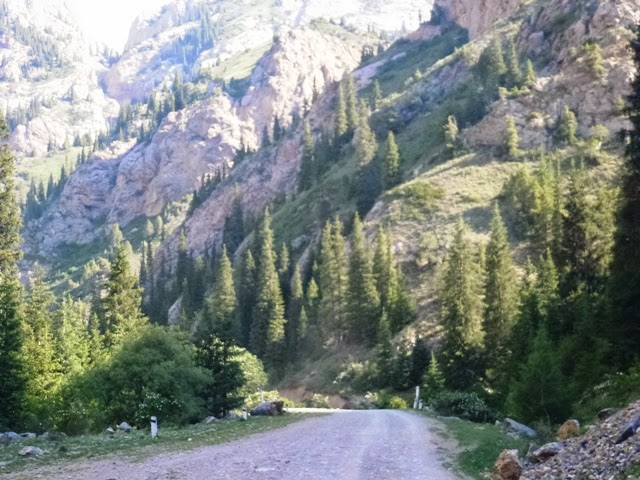
The Whippet seemed to enjoy the cold clean Kyrgyzstan air and Bill and I headed off like bats out of hell after the border. Forgetting that we had agreed to drive to Tash Rabat, and missing the half metre high sign, we finished up lost, and in the well-intentioned hands of a couple of locals in a well worn late '80's Audi (the car of choice here). Handshakes were exchanged plus the occasional shot of Stollie. Remember that this was in our first few hours in Kyrgyzstan and we had yet to purchase Kyrgyz SIM cards, so no phone contact.

Eventually we set off back to the last checkpoint with less than 4 litres to spare in the tank. Soldiers appeared from everywhere and in broken English explained that the Toyota and Dodge had set off down a side road to squat in a Yurt near the original Silk Road gateway (the caravanserai).

Two young soldiers, Bukyt & Syrgar (pronounced, and always fondly remembered, as Bucket and Sugar), kindly agreed to drive us to Tash Rabat, leaving the Whippet in the secure hands of the remaining 20+ checkpoint guards. In fading light we set off on a 50km trip into the unknown. Sitting in the rear seat we noticed the fuel gauge on empty as Bukyt pressed pedal to metal in his Nissan Bluebird. Just before the turn-off to Tash Rabat, Bukyt spotted the guage and phoned a friend who duly appeared in an old Lada 10 km further on and frantic petrol siphoning began.

With an additional 10 litres on board we resumed the search, arriving at the Tash Rabat valley in darkness at around 11 pm. A fruitless search through the first Yurt camp left us even more fearful that we may have to share quarters with our second best soldier friends. Finally Syrgar was inspired and directed Bukyt to drive to a small caravan. Awakening a soldier friend Syrgar kept repeating 'white Toyota Landcruiser'. Finally the friend connected 'yes I saw white Toyota Landcruiser at my friends Yurt camp today'.

So off we go again, this time testing the waterproofing on the Nissan as it careered through streams and paddocks into yet another Yurt camp. Success at last -- the white Landcruiser and 1920 Dodge sitting amongst the Yurts.

Hugs and congratulations with our new mates (our old ones didn't even wake to welcome us), and the wonderful Yurt owner offered a light meal and tea in solace. Much to their delight Bukyt & Syrgar secured 10 litres of fuel, barely enough to make it back to the border gate, and Bill and I secured a warm Yurt bed for the night and reunion with the team next morning. Next day, as we collected the Whippet from the checkpoint, the story had spread and cameras recorded the legend.

Rex Hewett

Ten grand

Congratulations to all our followers. Yesterday our blog passed 10,000 hits.

Thanks for your interest, stamina, and sacrifice of time that could probably have been better spent.

Cheers

The B2B Expeditionaries.

Wednesday, 9 July 2014

Felt and Community Based Crafts

The locals, with the help of a Swiss Group, have set up women's cooperatives to make and sell the felt and leather-based crafts produced mainly during the long winter months.

The felt is produced from local sheeps wool, working it into sheets by rolling it behind horses along the road. Of course Yurts are the main product and they are warm and cosy and keep out the chilling wind on the high summer pastures. Some are highly decorated both inside and out. Carpets are the next on the list to cover the floor of the summer yurt or at home in the village. Slippers and wall hangings, both embroidered, look great. Natural dyes are the fad and cases for phones and iPad are appearing.


Ian Neuss

The Road to the Sky, by I Neuss

A quick look at the map shows that there is a road from Naryn, west along the Naryn River, then north up to Song Kol. Looks good, looks easy, and we can continue north around the lake to Lake Yssyk-Kol. We leave Naryn late in the day and drive ‘til it’s late and camp on the banks of the large Naryn River at Ak Tal. We get visited by numerous locals some of whom offer us a drive of their car if they can drive ours. No thanks. They return with a few mates later for more photos and "can we have a drive" again.

It’s a short 125 km to the lake the next day, and a few bends, so we set out early on a beautiful morning. The road passes a few villages and farms and starts to go through a beautiful limestone gorge. The landscape turned from brown to green and pine trees started to appear and the road got steeper and rougher, and rougher, and stonier. Turning the corner at the end of the gorge all was revealed with the 9 switchbacks appearing up the hill.
Not a worry for both cars. A thousand metre climb to the pass and a few tourists coming down, jumping out of their cars to take photos. A few locals all packed up going to the summer pastures with their yurt and the kitchen sink were enjoying the beautiful morning as well. Coffee and lots of photos with local tourists at the top at 3400m and on to find a yurt to stay in.

All uneventful for the two cars.

Ian Neuss

Song Kol

Song Kol exceeds all cliches. A shallow basin surrounded by a ring of mountains, with the lake in the middle and the sky above. It's a bit over 3000 metres and has very changeable weather, and all three seasons, Autumn, Winter and Spring. We had blue sky, thunderclaps, rain and sleet.
We were made very welcome at Jolamon and Zamira's yurt-stay, described accurately by Naryn CBT as a good Kyrgyz family. The kids put on a show for us on the first night. To see our welcome concert to Song Kol click HERE

All audio-visual records of the reciprocal team performance of Waltzing Matilda have been destroyed.

Tex Hewett surveys his domain.

Our first yurt-stay

Tash Rabat is the location of a 15th century 'caravanserai', a resting place for caravans on the Silk Road (some scholars think it may be even older, a 10th century Christian monastery). It's in a valley, off the main road, with a number of locals happy to provide B&B in their spare yurts, all part of Kyrgyzstans' flourishing Community-Based Tourism (CBT) network. The Tash Rabat valley is a comfortable day's drive from Kashgar, China, even with Chinese bureaucracy and 2 cars with a combined age of 182 years.
We had worried about how to contact the CBT, but no need to worry as it contacts you (Tursu of Sabyrbeks yurts waved us down on the road), and their tourist information offices are findable among the jumble of street-front labels in most towns.
Sabyrbeks had the added luxury of a banya, in this case a stone sauna. Just the ticket after a long drive, in the bracing air of a 3000m mountain valley. The photo shows the banya in the background, with Ian eschewing the shelter of the yurt.

We would have no hesitation in recommending Tursu's Sabyrbek yurt-stay, especially the banya.

Kyrgyzstan on a handshake

After the gentle climb from Kashgar to the border post at the 3700m Torugart Pass, and the paper warfare of getting out of China, Kyrgyzstan opened up.

The two border officials walked up to our cars and SHOOK HANDS with us. They waved away our carefully completed visa applications, with photos attached, and stamped our passports. A couple of us walked through the Red - Something to Declare door, the Green - Nothing to Declare door was rusted shut, past the large Duty Free sign over the cobwebbed and empty "shop", and out the back door. After the usual photo-shoot of the cars, they waved us on. This meant driving to the boomgate, which was closed. We waited a minute or so before realising that this was a DIY border gate, so I got out, braving potential machine gun bursts, and lifted the chain on the gate, swung it open, and there we were, in Kyrgyzstan. We had been so conditioned to restrain our own photography with officials (and the recalcitrant Michael Noyce had gone home a few days before) that the only photo we have is one taken of us, BY the Kyrgyz officals.

The difference doesn't end there. To borrow a cliche, Kyrgyzstan is Big Sky country. The constant smog, and desert and cement dust of China disappears. The air is disturbingly clear, the mountains brilliantly coloured, only the roads disappoint.

Much more to come.

Xinjiang and "The Situation"

Xinjiang Province is also called the Uyghur Autonomous Region. The Situation is well known and security is visible everywhere, even in the city squares where people are dancing in the evenings.

Note the position of the trigger finger. He was probably more scared of his officers than any external threat.

I'm sure they'd rather be shooting unthreatening, funny old cars with their i-pads.

Xinjiang: by Ian Neuss

Xinjiang is the largest Chinese administrative division and borders Russia, Mongolia, Kazakhstan, Kyrgyzstan, Tajikistan, Afghanistan, Pakistan and India. It is also the home of 7 ethnic groups of which the Uyghurs are the largest. Reputably only 4.3% of the land is fit for human habitation. Its rivers disappear into the desert or salt lakes, fed by snow from the surrounding mountains.

The deserts are rich in salt, borax, oil, gas, coal and jade, with metals and gold in the surrounding mountains. The desert is also rich in subterranean water but most life and agriculture clings to the present water courses where cheap flood irrigation methods are available.

It is 1/6 of China and is divided into two basins, the Dzungarian and Tarim basins, by the Tian Shan mountains, and is surrounded by mountains pushed up by India, the Pamir and Karakoram to the south west, Kunlun in the south, and Altai in the north east. It has huge tourist potential and a rich and romantic history.

It is very poor with a very low GDP and it shows. The Uygurs feel they are being swamped by recent Han Chinese and they are. Although their standard of living has increased they feel their voice in local affairs is not being heard. This was felt by all in our travels through the region when ever we came in contact with Uyghur individuals.