The little village of Lahic is about 150km from Baku and is reported to be one of the charm villages of Azerbaijan. It's 20kms off the main road and you drive along a river valley through little villages and beautiful oak forests. The valley narrows and the road becomes rougher until you are driving on gravel with massive vertical mountains either side; very spectacular.
One km from Lahic a sign directed us along a dry river bed on quite rough river stones. After about 2km the track wound it's way into the village and after asking directions a few times we arrived at the really nice Lahic Guesthouse. It's a cross between a B & B, small boutique hotel and guesthouse. It is owned and operated by Rustam, a 67 year old former mechanical engineer who was at one stage during soviet times the assistant to the Deputy Prime Minister of Azerbaijan. This place has been in his family for many generations and in 2006 he proceeded to rebuild the old stone place and build 9 ensuite rooms. We had a lovely home cooked dinner and a fascinating talk with Rustam.
The village is at 1300m and has a very appealing micro climate; cool in winter and not too hot in summer. The day we were there it was in the mid 20s and very pleasant.
Before soviet times Lahic and surrounds were 10 times bigger with about 10,000 people. The soviets were disastrous for the area with many people gradually moving away and others sent to Siberia and Gulags with only about 5% returning. Pre-soviet the town had many small artisans for which it was renowned. Nevertheless, the soviets gradually rid Lahic of those artisans and the 'intelligentsia'. We saw in the dining area lovely metal handicrafts from the old days including some 18 century guns and knives which Rustam said were actually made in the village. Today, there is only a blacksmith; mainly for tourists.
Walking around Lahic it was interesting to see cows wandering along the narrow streets made of smooth river stones but with no grass anywhere. Then I saw it; an open door under a house revealed 2 cows eating hay in the semi darkness. Some things never change.
After a good breakfast of porridge, yogurt, omelet, bread and coffee we departed with Rustam in the Dodge until the village outskirts. The streets were very narrow, just wide enough for the blue Dodge, brown Whippet and white Toyota to crawl along. Instead of driving back along the dry river we drove right through the centre of Lahic which was just waking up. We saw the wood man with the donkey delivering wood, and the bread lady putting out her fresh bread.
A very interesting overnight stop in lovely Lahic with excellent accommodation and food, and a very engaging host.
Saturday, 4 July 2015
Friday, 3 July 2015
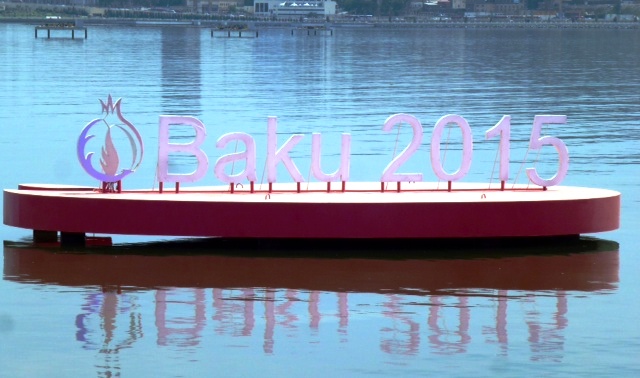
Welcome to Baku, the city of the 2015 European Games. Michael Noyce
After criss-crossing Baku in the convoy when entering Azerbaijan we almost felt that there might be nothing else to see in this city. Had we not seen all the main sites? But there is certainly much more to discover than was possible during our cavalcade and our 2 days was certainly not long enough to do Baku justice.
Azerbaijan is clearly very proud of being the host for the 2015 European Games and this was obvious throughout the city. Baku had a kind of Sydney 2000 feel about it with Games signs and flags and games people in their blue polo shirts everywhere you went.
The city has a real European feel about it. You could even be in Paris or Milan in many parts and every high-end and designer shop imaginable is here, often with multiple outlets. I went into Port Baku Mall, just near our hotel and there are 2 floors of absolutely the really serious designer shops, but the place was deserted. I was the only person walking around at 1-45pm.
There seems to be a bit of a building frenzy, no doubt with the games as a driver. There are certainly some very interesting and very modern glass buildings amongst some of the older style and soviet-era buildings. The main streets in downtown Baku are all at least 2 lanes and one way and the traffic moves pretty well.
The Old City is an easy walk from downtown Baku and it was a pleasure walking around its old narrow streets. We weren't put off by the many souvenir shops and enjoyed some lovely arts and crafts shops including carpet shops. Some of the old stone and timber buildings have been converted into restaurants as seems to happen when old areas are being restored in cities. Baku also has some lovely parks and Bulver Park on the waterfront is easily accessible.
It was a shame that time did not permit us to visit some of the many museums and galleries including the History Museum, Carpet Museum and the State Art Museum. There is even a Coin Museum and a Museum of Miniature Books; pretty unique I thought.
All in all, we enjoyed our stay in Baku and were presently surprised by its European feel with the European Games being a nice bonus.
Thursday, 2 July 2015
How not to arrive in Azerbiajan! Michael Noyce
It's 9am the day after we arrived at Alat port on the Shahdag and I am writing this blog from the breakfast restaurant on level 18 of the Baku Holiday Inn. I am looking down over Baku Port and can just see the 2 old cars in the distance with their covers on and impounded in the Baku Customs compound.
So, why are the cars sequestrated below and what led to this situation? Read on and see if you agree that this must be one of the most fascinating entries into a country that could be imagined; seemingly more fiction that fact, but nevertheless, just the facts.
Almost as soon as the ship docked at the Alat terminal guys walked on board and started measuring the cars. No-one spoke any English other than a few numbers and the word 'dollars'; somewhat ominous I thought. All the head guy could say was "one hundred dollars a metre". We quickly did the maths and the total length of our 3 cars was 10.80m; much money was now at stake. We were protesting a bit which probably only aggravated the head guy who was pretty stroppy and frankly quite rude, but it was his country and he made the calls.
The next surprise was that through the German father, who learnt some Russian while in the army 40 years ago, the head guy made it clear that we would have to go to Baku, pay the money and get Customs clearance before the cars could be driven off the ship. That would mean coming back tomorrow to pick up the cars. It was becoming quite ridiculous and the head guy even more agro.
Then the Captain appears and he looks pretty cool. He has shaven, is wearing a red Ralph Lauren T Shirt and white slacks. I explained the situation as best I could and he does, I think see the absurdity of what the head guy is demanding. Much talking and hand gesturing now between the Captain and the head guy and after a few minutes the Captain nods to me and I saw that as meaning; it's OK. He says "No problem". The head guy now measures the vehicles again and this time tells us "Eighty five dollars". From $100 to $85 in only a few minutes of the Captain intervening and I am thinking we might get away with this for not much at all.
This is what we need to do. Chris, the German father is to go with the head man in his car, basically as a hostage Chris says. The rest of the cars will follow in convoy for 75km at no more than 60kph where the limit is 120kph. So, the convoy order is to be the head man and hostage, Bill and the Whippet as it's the slowest and will set the pace for the head man, then the Dodge, then the German son driving the red Fiat and tail end Charlie is the Toyota.
Can you imagine the absurdity of all this. But it gets much worse and becomes an unmitigated farce, as you will see. All because of the lack of processing procedures and facilities at an international ferry terminal!
By various hand waving the head man directs us to immigration, about a 10 minute walk. Up we go and being a passenger I am the first through with Gerry the nominated Toyota driver. This takes about 20 minutes and we are directed to the Ports office and each pay US$10 Port Tax. We go back to the ship, Gerry backs off the Toyota and we are directed to Customs about 300m away. A customs guy directs us over the pits, but they seem little interested in the Toyota or what might be in it; A sniffer dog comes along and few sniffs and he is gone.
We wait and wait and it's approaching 4-30pm. Then in the distance we see the Whippet emerging off the boat and soon the blue Dodge. And now the photo opportunity for the Customs boys starts. They don't even put the old cars over the pits or let the sniffer dog loose; just photos, photos, photos.
We line up in convoy with Chris the hostage in the head man's E Class Mercedes in the lead. He is living proof that thieves do in fact prosper. And we start; only 75km to go and it's approaching 5pm. It's a nice trip up the coast, parts we did not anticipate seeing, but nevertheless we do enjoy this opportunity that few tourists experience.
We approach Baku and turn off the 8 lane freeway. The lead Merc stops. He is lost and the chatter over the radio between us is less than flattering. Now it's well after 6pm and whats the guy trying to do? After all, we have an hotel to get to.
We are driving in Baku with tall glistening glass multi stories mixed up with the old town and run down slums. We stop many times for directions and also because we are in peak hour Thursday night traffic and some roads are closed due to the European Games. We are getting spread out and the call comes from Bill "Can't see you, close up close up. I am stopping" and hopefully the lead Merc stops too. Ian calls out "Billy, my brakes can't take much more of this" but our big fear is the Whippet running out of petrol in peak hour traffic in downtown Baku. Yes, it's a very real concern. We seem to be going around in circles and didn't we go past that building 1/2 an hour ago?
We approach some gates, the Merc stops and the head man talks to someone. Through the convoy goes and stops outside a kind of demountable office. We go inside and each of the drivers must pay the amount based on the length of the vehicle. It takes about an hour and then the head man says we have to wait for the Customs people. But weren't we cleared by Customs 7 hours ago at Alat?
We wait about another hour and the head man then advises that we must drive to Customs about 4km away. It's utter madness and Chris suggests that only the drivers go in the Toyota and that the old cars stay with the German son and I. And this is what happens and we can even see the Holiday Inn, our hotel a few hundred metres away. So close but so far.
In the end it seems that whilst we as individuals have a 30 day visa the cars must leave the country within 3 days of clearing customs. Try working that out. So, the boys reach agreement with Customs to leave the cars impounded for at least another day and we arrive at the hotel about 9-45pm for a 10pm dinner.
The sequel the following day is that the boys went back to Customs, paid the US$20 road tax per vehicle and all is ok. The Germans drove their Fiat out and will leave for Georgia the next day, and we will leave for Georgia in 2 days. A hellava frustrating drama that is nice to reflect on but not so good being in the middle.
And that's how we come to be in Baku, Azerbaijan, the venue for the 2015 European Games which closed 2 days after we arrived. Welcome to the Games city; it's a bit like Sydney 2000. Yes, true.
A journey across the Caspian Sea, Michael Noyce
We arrived at Turkmenbashi in the late afternoon not knowing when we might be able to catch a ferry across the Caspian Sea to Baku in Azerbaijan. There is no timetable or schedule of any kind and all the blogs, guide books and websites simply suggest that you turn up and wait until a ferry is full and ready to sail. Also, it's pot luck what kind of ship you might be on; a rail freight ship with some basic cabins for a few passengers to the newer Turkman with much better facilities and even showers.
As we drove into Turkmenbashi we could see an old rail freight ferry in dock. We checked it out but no-one could tell us when it would sail. A few passengers were spread our in the waiting room, but we certainly weren't going to do the same. After a 12 hour drive through the desert and in the heat we needed a nice hotel, hot showers and wi fi, even if we missed a ferry that night.
Next day we checked out what ferries were in port and the old blue one from the previous night was still there but sailing soon. We had a very short time to pack, process customs etc and be on board; a big rush it was, but we made it. We anticipated the usual paperwork and bureaucracy and weren't disappointed but overall it went pretty well. Only one slight hiccup. Half way through processing my passport there was a blackout and the guy told me sometimes it lasts a day. Oh no, so close but so far, but all was well and the power came on after about 30 minutes.
A German guy and his son with a Fiat transit van were also with us so that made 4 vehicles. Coming aboard was interesting. As we were passengers, the young German and I boarded while the four cars and drivers were still being processed. We walked along railway tracks up to the back of the ship. A very big iron door was open and we could see right into the ship; 3 rail lines and railway carriages with just enough space we thought at the back for 4 vehicles. There were 2 men standing there as we walked along the railway tracks; both with about 3 days of black facial hair, one with a shaven head, white tight fitting T shirt and wearing slim camouflage coloured long pants. The other guy wore a T shirt and black trackies. We thought we had met a couple of pirates and the first thing the camo man asked for was US$90 for a bed. I was about to pay but remembered what Ian had told us; don't display US$ and to say we only have Visa and we will then be able to negotiate a better price for the cabin. Oh really?
It was not to be and before long the cars drove along the railway tracks and were aboard. Ian pretty soon realized that the camo man called the shots and we all paid the money and were settling into our cabin. It turned out the camo guy was the ship's captain and the black trackies guy was the first officer. The captain was a pretty nice guy and invited us onto the bridge which was of much interest to Bill with his fascination with all things mechanical.
The ship was Shahdag and built in 2005. It is 154m long and weights about 8,500 tonnes. It is a cargo ship that carries rail carriages on 3 parallel tracks on the bottom deck. The carriages seemed to be full of bags of construction materials such as sand and gravel. Our four vehicles were parked right at the back and there was basically no room for anything else. The ship had a few spare cabins for passengers.
Let me describe our cabin; 3 double bunks, 2 portholes and one that opens, a wardrobe with broken and dusty shelves, small wooden table and 1 chair. We were sharing with the German guy and his son. Simply put, it's probably what a 6 man gaol cell is like. Opposite is a toilet but no paper and there does not seem to be a shower. All for US$90 a person including dinner tonight and we assume some sort of breakfast tomorrow. Bill was relieved when he saw a life jacket sign on one of the wardrobe doors. He opened it and then exclaimed "Shit, where are they". He is still looking
The only lounge on board comprised 2 small lounge type chairs, a ping pong table without net, bats or balls, a rough looking wooden coffee table and a 5 seater half circle 'lounge'. On one wall is a crackly flat screen TV. At the opposite end is a big colored portrait of the President of Azerbaijan.
Dinner was at 8-30pm and the six of us sat in the crew's dinning room next to the galley. There were 2 women on board who seem to be be jack of all trades and with one more focused on the kitchen. The other made our beds, gave me afternoon tea, set up the tables, served us and it would seem anything else required such as washing and cleaning. Both are nice and friendly. We had Russian borsch soup and then some kind of vegetable dish with a chicken.
We had earlier chosen our bunks and were pretty well asleep by about 11-15pm. Ian decided to sleep in his swag which he rolled out next to the railway carriages on the bottom deck. At some stage during the night he lost his sense of adventure and moved onto the remaining top bunk.
Surprisingly, we all sleep pretty well and the air con in our 'cabin' actually worked. Breakfast was stale bread, cheese, metala, jam and luke warm black tea. We survived ok and to fill in time we chattered amongst ourselves and also looked across the Caspian at other ships and the many oil drilling platforms. And we even had lunch; lentil soup and chicken and macaroni.
The Captain told us we would not land at Baku as expected but at Alat a new port about 75km south of Baku. Soon we could see land and waited as the ship edged closer and ever closer to the pier. It was very interesting seeing how this quite big ship was able to maneuver backwards with it's rear door wide open, right up to and then connect with the rail lines on the terminal.
We had successfully crossed the Caspian Sea from Central Asia to Europe. The journey was really just part of our continuing adventure, had been without incident and was actually a fascinating experience, a lot of fun and the ship's crew looked after us quite well. We did not quite know what now to expect and thought from all the confusing blogs and websites that we would need to pay something for the cars entering Azerbaijan.
Little did we know what would await us over the next 7 hours, but that is another story of fact not fiction, although it might seem like one tall tale from a writer of TV fiction.
Wednesday, 1 July 2015
Reflections on the Silk Road. Michael Noyce
On my last day in Tbilisi before flying back to Sydney I was reflecting on some of the fascinating 'cameos' from my amazing adventures through the Stans.
I remembered day 2 of exploring the historic Fergana Valley in Uzbekistan when we were having breakfast in our modest hotel in Kokand. In the days of the Silk Road this city was at the crossroads of the ancient trading routes.
So it was interesting to meet at breakfast a modern day Silk Road trader. The man was a Uighur from Kashgar in China and was in Kokand on a trade mission. Our guide then gave us a short history lesson about the Uighurs and their trade routes and how their caravans would have travelled through just where he was now having breakfast.
Our new Uighur friend was following in the footsteps of his ancestors and in a modern sense, continuing their ancient traditions of commerce and trade. As much as things change, many stay the same.
Later, on the road to Tashkent we drove through a village called Qashqar, or Kashkar, as our map also showed. But isn't Kashgar in China? Our guide explained that in the days of the Silk Road many traders simply settled and named their area after their hometown.
Just like home, with Paddingtons, Richmonds and Brightons. Glad to see these true Aussie values so far away.
Monday, 29 June 2015
The 'Stans and the Great Patriotic War.
As the Bondi to the Baltic Silk Road journey enters Russia it is interesting to remember the many memorials commemorating the sacrifices made by the ‘Stans and Southern Caucasus in The Great Patriotic War against Germany in WWII. We also saw many banners and signs commemorating the 70 years since the end of the war. Exact death numbers are difficult to ascertain with accuracy but the following will give some indication of the deaths in these countries; Kazakhstan 490,000, Kyrgyzstan 90,000, Uzbekistan 330,000, Turkmenistan 70,000, Tajikistan 50,000, Armenia 150,000, Azerbaijan 210,000 and Georgia 190,000 (Source: Wikipedia).
Combatants from these countries were involved right from the start of the German offensive in June 1941 and in all the major battles including the defence of Moscow, the battle for Stalingrad and the capture of Berlin in may 1945. Hero of the Soviet Union was the highest award for bravery and 497 were awarded to combatants from Kazakhstan, 73 to people from Kyrgyzstan and many to those from the other countries. It was not only with combatants that the ‘Stans contributed. Industries and factories were relocated from war zones in the east to the safer areas in the ‘Stans and many people were exiled to the ‘Stans, such as Tatars from Crimea and Chechens, as Moscow saw these people as potentially subversive to the interests of Russia.
On my first day in Almaty, Kazakhstan, I was amazed to see in picturesque Panfilov Park the massive sculptured monument about 15 metres high of oversized soldiers and the eternal flame. This commemorates 28 soldiers who died in the defence of Moscow. During our trip we saw many monuments including a beautiful memorial next to Independence Square in Tashkent, a huge one in Ashgabat and many smaller ones in local communities. The photos will give some idea of these memorials which very much reminded me of the many memorials across Australia.
Michael Noyce
Sunday, 28 June 2015
Living history - from the Bolsheviks to the iPhone. Michael Noyce
I am writing this blog from the city of Mary in Turkmenistan where a really lovely Turkman was born in 1919, ninety six years ago and the year the Bolsheviks took over the area. This man has experienced all the historic events in Central Asia over the last 100 years and his story is, to me, simply remarkable, as is this wonderful old guy.
His ancestors were Turkmen and always lived in the Mary area. For over 200 years the family built up a very successful carpet making business and when the Bolsheviks arrived were very wealthy. The Bolsheviks introduced collective farming and demanded that the family's successful business become State owned. The 96 year old's father, as head of the family, resisted but the pressure continued from the Bolsheviks and the persecutions increased. In 1931 the father decided to leave Mary and escape to Afghanistan which was a free country.
They arrived in Afghanistan with virtually nothing, except their skill and hard work ethic and over the next 40 plus years again built a very successful carpet making business, with, by this stage, the 96yo as head of the family. He had only 1 wife and together they produced 11 children of which 9 are alive today with a 30 year age spread. Much of the labour making the carpets were Afghan orphans in Kabul which the old man employed to take them off the streets and give them a home and life skill.
In the early '70s the old man went to the US to a university in Pennsylvania and lectured for a few years on textiles and dyes and associated topics.
And then came the Russians when they invaded Afghanistan. The old man and his family tried to stay away from politics and when he wanted labour he would arrange with the Russians for more orphans. He said it was hard with the Russians there but they got through these times relatively OK. Most of his kids went to university in Kabul and are now spread between the Stans, Canada and the US and are very successful as doctors, scientists and in other professions.
After a few years the Russians retreated and Afghanistan became more 'normal' again.
The third tumultuous event for the old man was the breaking up of the Soviet Union and the independence for the various countries in the ‘’Stans. The old man chose Uzbekistan and in 1991 moved to Samarkand and set up the family carpet making business. Over the next few years most of the family came to Samarkand and today the family's carpet making business is the biggest in Uzbekistan while still maintaining the Afghanistan side.
They employ over 1200 people around Samarkand and their approach to people management is almost worlds best practice; quite remarkable given where they are and where they have all come from over the last 100 years. One example is that women are given long term paid maternity leave and if they want to stay home and look after the kids, looms are set up at home. The old man's 23 year old grandson gave us a tour of the main factory and warehouse and over the next few days we became quite friendly with the family. This culminated in the old man's son coming to Bukhara when we were there and hosting us on our last night at a magnificent private dinner on the eve of Ramadan which started the following day.
At exactly 9.19pm we heard a kind of wailing sound coming from the old man's pocket. He smiles, puts his hand in his pocket and out comes his iPhone. He has a Ramadan app and it's the call to prayer. And he is still wearing his Hugo Boss jumper under his designer suit, which he always wears.
So, here is absolutely living history; a man born into free Turkistan, overwhelmed by the Bolsheviks, then experiences the Russian invasion of Afghanistan, embraces the breakup of the USSR and the independence of the Stans and now is part of the iPhone world and modern Western fashion.
He was an engaging and delightful man with reasonable English and always wore a special Afghan cap. ‘It was made from the wool from around the neck of a just born and slaughtered lamb and I think is called qorakol wool. We felt somewhat humble in his presence and almost overwhelmed being with a man who has lived through the incredible history of the Stans over the last 100 years and is still embracing the emerging new world of today.
And finally, the story of a wealthy family resisting the Bolsheviks and then escaping to Afghanistan is not unique. ‘The story of our guide in Turkmenistan was similar. They were wealthy Turkmen and his great grandfather resisted giving all his livestock to a collective farm. He was taken by the Russians and never seem again. The family escaped to Afghanistan.
3 generations in the Dodge with. His 46yo son, a doctor and now managing the business, 2 of this US educated grandsons and his 69yo brother (between the grandsons) who managed quality control.
Saturday, 27 June 2015
The mounds of Turkmenistan, by Michael Noyce
Driving through Turkmenistan we would see from time to time large earth mounds of varying sizes. They could be 20m high, 100m long and quite wide and even bigger. These mounds are progressively but slowly being excavated by archaeologists and are very ancient. On the way back from visiting the Bronze Age archaeological site of Gonur Depe we stopped way off the beaten track and saw a partially excavated mound that revealed a 5th century Christian church. It is believed that many mounds cover 'caravans' which were stopping places for the camel trains on the Silk Road, as camels could only go about 25km a day.
Just outside Ashgabat we made a slight detour to see the remains of an old mosque that was destroyed in the 1948 earthquake that destroyed all old Ashgabat and killed 90% of its people. From there we could see two large mounds; one from the Stone Age and one from the Bronze Age. Excavations of the Stone Age mound in 1904 by a US archaeologist revealed wheat that was at least 8000 years old; the oldest wheat yet discovered we were told.
And that is only one of the remarkable things about Turkmenistan. There is so much history here and still even more waiting to be uncovered; a truly fascinating country.
The horses of Turkmenistan, Michael Noyce
A day or so into Turkmenistan our guide Jabbar told us that horse racing is the national sport, even without betting allowed. From what we have since learnt from him, this is quite understandable.
The horses for which Turkmenistan is famous are the Akhalteke horses. They go back to at least the Bronze Age and the Turkmen are legendary horseman. Traditionally, every family owned at least one and basically treated them as a family member. In 1879 the Turkmen defeated Russian Czarist troops in a battle near Ashgabat. The Czarist General escaped back to Moscow and reported that it was the Turkmen horseman that gave the Turkmen the edge.
The following year Czarist soldiers returned and in revenge for their defeat the previous year slaughtered 20,000 Turkmen on the site where they were defeated earlier. The Russians thereafter controlled the country and we were told that no Turkman was permitted to own a horse. The Czarist Russians killed many thousands which only further upset the locals. Apparently after that, both the Czarist and the subsequent Communist governments maintained about 1000 of the horses in a government stud farm, so the breed was continued. The Turkmen were proud of their horse heritage and in 1935 they were able to obtain about 30 of the Akhalteke horses and ride them from Ashgabat to Moscow in a journey of about 4,300km in 84 days.
This brought the Akhalteke horses to the attention of the Russian leadership and in 1945 Marshal Zhukov who led the Russians in the capture of Berlin (and the Battle of Stalingrad), rode a black Akhalteke stallion in the victory parade in Red Square. In 1956 President Nikita Khrushchev presented a golden one to Queen Elizabeth.
The Turkmenistan national emblem includes an image of an Akhalteke horse. The last Sunday in April each year is National Horse Day in recognition of the breed. Paintings and pictures of Akhalteke horses are in many places including most of the hotels where we have stayed. The only photos and paintings on the 2 floors in our hotel in Serdar were of these horses including a very lifelike painting of the current President wearing a large white fur cap riding one.
So what do mosques have to do with horse? Heaps, because the first mosque built after independence was on the site of the 1880 massacre of the 20,000 Turkmen by the Czarists and this mosque was built in their memory. In the 1880s there were about 440 mosques in Turkmenistan. At the time of independence in 1991 following the communists there were only 5 mosques remaining.
Jabbar took Gerry and I to see the Akhalteke horses at stables in Ashgabat which was part of a large racing and training complex next to a racecourse. We met the head trainer and he told us whilst the horses are not always as fast as European horses they do very well in distance races and particularly well in long endurance races of which there are many in Australia. The guy showed us around the stables and we saw a really beautiful golden stallion which seems to be the 'signature' colour.
You don't need to be a horsey person to appreciate these magnificent Akhalteke horses and their part in Turkman history and the national identity.
Friday, 26 June 2015
Ashgabat, Turkmenistan - fantasy city or what? Michael Noyce
Ashgabat is the capital of Turkmenistan and was virtually destroyed in 1948 in an earthquake that killed 90% of its people. It has to be seen to be believed. The modern Ashgabat has been built since independence in 1991 and is a cross between Las Vegas, Dubai and Disneyland. There are wide open six lane streets, massive monuments to the last President and the present one, huge buildings but no real high rise. All the building are basically white marble from Carrara, Italy, and this has kept the Italian economy afloat for years. We did a tour around Ashgabat before we went to the hotel and it was quite amazing, but with no people on the streets, understandable due to the 50c heat.
Although it's hard to describe individual buildings many have something symbolical on the top. For example, a beautiful building of a bank has a huge gold coin glistening on the top and I think it is the Ministry of Gas which has a symbolical gas flame on the top. The Arch of Neutrality is at the end of a long, wide boulevard. The whole thing is 40m or more high and on the top is a 12m gold statute of the former President that used to rotate once every 24 hours.
Many people have suggested to us, as do some guide books, that the new Ashgabat is totally over the top and lacks taste. I actually think it's magnificent but the final test is what the locals think. After all it's not up to us to judge. The locals love and are very proud of Ashgabat. Let the case rest.
And let our readers make up their own minds from the photos with this blog.
Wednesday, 24 June 2015
Wine, the international currency. Michael Noyce
On the drive to Khiva John proved that wine really is a universal currency and can overcome even the most challenging situation. He was driving the Toyota and came to a police checkpoint. The protocol is that the vehicle must pull up at the stop sign and can then drive on, unless the policeman indicates otherwise. John stopped but the policeman then signalled him to drive to the side and stop. He did this and the policeman walked up to the car. He showed John his license, indicating that John should do the same which he did. He then wanted to inspect the back of the Toyota which was full of luggage, boxes, a fridge and a case of mixed red wine.
John opened the back and the guy saw the box of wine. "Ah, vodka, vodka" he says and John replies "Nyet, vino, vino". The copper then beckons John to the police station and John starts to think about what this is going to cost and does he have enough $US? He asked to see John's license again and the Toyota registration papers which John gave him. At this stage John is seriously concerned, as are Ian, Gerry, and Bill in the Toyota. The guy then beckoned John to go back with him to the Toyota. The policeman opened the back again and says "Vino, vino". John looks at him in a confused way, not quite realising that the guy wanted some wine. Then it dawned on John and he responded "Da, vino" and lifts up a bottle and points to the guy. The copper says "Da, Da" and with that John hands him the bottle, they shake hands, Johns gets back in and the journey to Khiva re-commences.
The sequel is that the bottle was one of six we bought for about A$1 each, as part of a mixed case of reds with an overall average price of about A$1.40. It was the cheapest we could find and was not the best. So John's 'indiscretion' at not stopping properly cost us the huge sum of about A$1 and proved that wine really is a universal currency. Now we carry a bottle of the Bagizagan wine (pictured), not necessarily to drink but because it might come in handy at the next police checkpoint.
Samsas on the Road, by Ian Neuss
On the road we tend to eat when and where we can and whatever we can. So far that has not led to any disasters mostly due to the build up over the years of a wide variety of bacteria in our systems and having kept clear of these new antibacterial hand-washes to protect our natural resistance. But that’s another scientific experiment blog brewing.
I have found samsas to be delightful and a good road food. In Samarkand Bill and I were off early to service the cars and passed the corner samsa maker and picked up four samsas made from puff pastry. These, straight from the oven, were the best we have had so far. This fact is supported by the constant occupiers of the four roadside tables outside the oven. We also found a lunch spot in Bukhara that made alat samsas and went back there a couple of times and got vegetable-only ones as well as the usual mutton ones. A great flavoursome snack. In Nukus we had round fitchi that were not enjoyed by all as they are very rich in mutton fat. Bill needed a stomach pump and a coke to kill the fat.
On the way out to Gunup on the edge of the desert, after an early start to beat the heat, we stopped for bread and were lucky enough to find the ladies were making samsas. We got a demonstration on filling them with mutton, onion and mixed herbs, folding and putting them in the oven. Then of course we had to wait ‘til they were cooked and try them. We bought 10 straight from the oven to take with us plus a loaf of bread with mutton in it which surfaced from beneath a huge pile of clean, well worn blankets keeping the loaves warm.
We took the samsas with us to Gunup and shared them with the caretaker who had not eaten for a week. We thought they were good and delicious but he thought they were from heaven and the way they were wolfed down left me for dead and that’s worth noting. (He’s dressed in an overcoat and fur hat and it’s 40 degrees in the sun, but it’s probably not as hot as it gets and he can take them off and feel cool when it does get hot).
Bill's dog story. Bill Amann
On the way to dinner the other night, at a truck stop half way across the desert, I met a nice dog, a nice big dog, nice big very friendly dog with a huge head which counter balanced the you-know-what knots at the other end. The head was big and flat with blue specks in the white patches, something like a heeler with big feet, with the same markings, and a particularly large muzzle full of teeth, slightly out of proportion with his huge body. He looked pretty interesting: no ears, no tail, pretty mangy and very unkempt. I stopped to have a word: “You’re a particularly ugly dog” I said in a strong voice and used the universal dog sit signal taught to me by a special dog whisperer, an upturned hand not too close to get bitten.
He sat down to put me at ease as he was a very big chap of possibly 50kg and quite scary looking, more so if you haven’t had rabies shots which were recommended for this part of the world. He held out a paw to shake hands (which is very important here as a proper greeting) and he told me his story – a pretty impressive story for a dog in the middle of the desert but pretty representative of the Turkmen.
He was born somewhere between Russia and Afghanistan, and Iran to the south, on the Silk Road actually, flat lands which are basically deserts that run goats, sheep (now only 3million) and half a million camels, not too dissimilar to the outback Oz, but ironically we have a lot more camels of course. I thought a reasonably short straw for a dog in a country that doesn’t really like dogs and cutting his ears off is a bit over the top I thought. He explains in a diplomatic way that jumping to unfounded conclusions about their customs isn’t quite right. This became clear later, he didn’t really care about his ears, he didn’t really care too much about the superficial.
He was bred for a tough life, but some overall purpose. The tough bit started young, not too long after he was born they cut his ears and then his tail. Not a real good day. He thought that was pretty good because they left the other bits and he had heard what they do to little boys in some parts of the world. I will take the ears any day, he thought. His first job was actually child labour but he worked with his family and basically had a good time and got fed too. They all worked together in looking after sheep and goats, a nomadic type of life like all the early Turkmen prior to Soviets. He and his brothers had to fight off jackals, wolves and foxes to protect the sheep and his owners who actually like him and loved the horses. The lack of ears and tail was quite handy as the wolves cannot get hold of them. Same with the tail, and he can’t remember it happening anyway, so why sweat the small stuff. Fewer grass seeds too.
Plov is a Turkmen dish made with rice vegetables and meat certainly good in winter where it may get to minus 40C, generally made with lots of oil. These sheep can withstand pretty tough conditions, similar to Australia but much colder in winter, they have the daggiest looking coats but are not grown for wool. This dog can certainly see the positives and is very friendly and content with his position.
His best job has been with the fabulous Turkmen horses, certainly the best looking horses in the world with golden shiny coats and incredible stamina, not dissimilar to the Arabian horses in looks. The Turkmen respect and value the horse far more than they do in Kazakhstan where the horse is raised for the lean meat. These horses, as history goes, helped them defeat the Russian expedition of 1879 where the fast moving cavalry did over 10,000 Cossacks. Pity the Russians paid the penalty the next year and killed most horses in the country not to mention the Turkmen. This dog’s got a long memory.
Since independence and his secure position with sheep has finished he has split up from his family and has to grub (bad pun by dog as this is a name for rice soup) a living from looking after the yurts and occasional vintage car at the truck stop. I think he was happier under Soviet rule with security, a good education and strict rules to work, but he’s not a capitalist dog. By the way he says don’t worry about the car as none are stolen because up to five years ago car thieves were hung and people have not got out of the habit, as he ate the chicken from dinner
He reckons he is related to an Italian type of dog that came through here in the thirteenth century called Marco but I think he may be related to Chengis like everyone else in this part of the world. He also tells a good story like the lion, witch and wardrobe that comes from here. He never told me his name but it could be Ashlan. The cars were still there in the morning.
International diplomacy
Ian is shown here working on the rehabilitation of Australia’s international reputation for selfish, paranoid, jingoistic cruelty to the most wretched refugees of the earth arriving in leaky boats. He is wisely starting with the next generation of Uzbekis.
Impressions of Uzbekistan, Michael Noyce
A visit to any country generally requires a visa and entry through a border. Many visas are simple formalities and entering a country quite easy. The opposite is our experience here. Obtaining our visa necessitated a number of visits to the Uzbekistan Consul in Almaty, Kazakistan, and with quite a bureaucratic process to follow. Entering the country from Kyrgyzstan was a 5 1/2 hour experience of bureaucracy, patience and photos opportunities of the old cars for the customs people and police. All the people were nice and polite, but nothing was simple
The people of Uzbekistan are wonderful, very friendly, helpful and always welcoming. We had many delightful experiences of the people offering accommodation in their homes, sharing food and drink and generally being warm and hospitable. Despite the warnings by DFAT we always felt safe and secure. We spent 3 days travelling around the beautiful Fergana Valley which has been the scene of considerable unrest in prior years. Security was tight with many checkpoints with armed police, but these were fewer and fewer the more we travelled throughout the country. In fact the police are not even armed in many cities. We were told in Samarkand by two different sources that it's completely safe to leave your car open on the streets and that car theft is virtually unknown.
We all like to keep in contact with home and this was sometimes not easy with wifi very, very slow in many places. But the good news is that there was free wifi wherever we stayed, though often with insufficient bandwidth to download newspapers or conduct a Skype conversation. Nevertheless, we could always email, even if a little slow.
The history of Uzbekistan and it's part in the Silk Road story is terrific. It's a very ancient country and this can be appreciated in the history museum in Tashkent and from visiting the wonderful Silk Road Cities such as Samarkand, Bukhara, Khiva and many others. Even the small ceramics town of Ristran in the Fergana Valley is ancient and we met a family whose ancestors have been in the ceramics game on the same site for over 1000 years; great succession planning. Alexander the Great, Genghis Khan and Tamerlane conquered the country. In Tamerlane’s Mausoleum (photo) in Samarkand, the Gur-e-Amir (Tomb of the King), we saw a map showing the extent of his conquests in the late 14th century; from Delhi in India, all of Turkey, most of Central Asia and west into Syria, Lebanon and Egypt. Pretty amazing and unknown to me. And we should not forget the Tsarist Russians from the 1860s and then the Bolsheviks from the 1920s.
Nukus, a town about 100 kms north of Khiva, is the gateway to the Aral Sea and has the outstanding Savitsky Museum of Soviet Art. Ian, Gerry and Bill toured the museum and thought it was wonderful with over 90,000 works of art, mostly avant-garde, but only a small proportion at any one time on display.
One of the great blights on Uzbekistan is the draining of the Aral Sea during Soviet times for cotton irrigation, and the decimation of many communities that depended on the Aral Sea for their livelihood. Whilst we did not go as far as the Aral Sea we saw huge areas growing cotton, all flood irrigated by water from rivers draining into the Aral Sea. A real negative on the one hand, but cotton is important for the economy on the other hand.
It's pretty easy driving around the country and the roads are generally quite good, except for much of the road from between Bukhara and Khiva. There is a great 4 lane concrete highway being built and about 150kms is finished. But much of the rest is pretty bad, with driving difficult in parts as it seems little or no maintenance is being done, pending the construction of the new concrete road. But whilst car travel is nice, it's another experience to travel on the excellent train system as John and I did between Samarkand and Bukhara.
We loved the food, with Uzbek salads of tomato and cucumber, and shaslicks of lamb, beef, chicken and vegetables—all very nice. We had the lovely rice based national dish, Plov (Russian), or Palow (Usbek) a number of times and enjoyed seeing how it is slow cooked in large pots.
We have generally experienced a hot dry climate with temperatures up to 45c in Khiva and then the next day a very comfortable low twenties as a storm came from the desert; but no rain anywhere. As expected, the further north and west we travelled the hotter it became, and we can expect even hotter weather in Turkmenistan
Politics. Islam Karimov has been President since Independence in 1991. Whilst he may be sometimes criticised by the west, the people seem to like him, and particularly, because he has made the country safe, or so people tell us. We met a pretty good cross section of people and I heard no criticism of Russia, except from some Russian hitchhikers. On the train to Samarkand, John George and I conducted a straw poll of 4 Uzbeks in our 6 person compartment; thumbs up for Karimov, Putin, Gorbachev, President Kennedy and the Clintons. Thumbs down for Stalin, the Bushes, and a big boo for Obama. Not scientific but interesting.
One final point; despite my own assumptions, most if not all we spoke to remembered Soviet times with some degree of fondness; everyone had a job, education and medical treatment were free.
All in all, a lovely, fascinating, friendly and safe country, and I do hope to return in the not too distant future.
Monday, 22 June 2015
Football wins at the border, by Michael Noyce
The border crossing out of Osh from Kyrgyzstan to Uzbekistan was a five and a half hour nightmare of bureaucracy, patience and frustration. For John George and me, walking through, it was easy compared with the boys with the vehicles. For them there were multiple checks of the cars and paperwork, and even police sniffer dogs.
But it was easier still, for an unexpected reason. After filling out multiple forms we lined up before a customs guy. When our turn came he looked at our passports. "Ah, Orstrala" he says,"Mark Cahill". What's he talking about, we think, but naturally we say "Da" in our very best Russian. His face brightens. Maybe we will be OK. Then he says "Mark, Mark Mark" with a questioning look on his face. Then the penny drops – Soccer – and we are instant experts. A very 'informed' conversation somehow takes place with gesturing, smiles, hand waving and whatever it takes and he waves us through.
If only we could have recalled the Asian Cup played in Australia in January. The Uzbekistan White Wolves held Asian powerhouse Korea to 0-0 for 90 minutes only to go down 2-0 in extra time. He would have thought we were geniuses.
Meanwhile the boys are still waiting and posing before their cars. It's almost 5 hours before they are through.
Wednesday, 17 June 2015
Samarkand, Then and Now, by Ian Neuss
My first trip to Samarkand was in 1975. I was on the Trans Siberian Railway and taking side trips to various places, all organised by the Russian Intourist agency, and paid for in advance in US$, right down to every meal. You got a book of tickets for breakfast, another for lunch and another for dinner, for every day of my trip.
It was December 1975 and cold all the way. I had been working in Indonesia and had to buy a coat in Japan for the trip. I had flown to Samarkand via Tashkent from Novosibirsk, where I had got off the train. I remember it well as I was met off the plane by a lovely dark haired Uzbek Russian guide, and I was the only one travelling at that time of year.
We went to Tamerlane’s Mausoleum and the local bazaar, and a city tour. I got the state-approved tour. The mausoleum was huge, in a bare area with the famous blue tiles on the roof, but little else. Today it’s been restored, polished, paved and decorated, and there are lots of domestic and foreign tourists plus people everything nearby. I stayed close by in a Soviet hotel, on a floor with a babushka who logged your entry and exit and took your key. After a day tour I think I ditched the guide saying I had a cold (which I did) and would stay in the hotel. I remember roaming about the bazaar and the mausoleum later by myself and being taken underground to see the tomb by local kids. That is not possible today. The bazaar was great and full of locals who all looked like Genghis Khan.
It’s changed today, lots of colourful women selling goods in stalls, much more organised and a greater variety of goods. Everything is new and bright and restored. There are shops full of goods lights everywhere. Cars, taxis, buses and people on the streets, domestic tourists in abundance. Colourful clothes on both sexes, smiling faces, and restaurants full with people enjoying themselves.
Update on the cars. Ian Neuss
The 3 cars were left in warehouse of Kazakhstan - Australia LLC, on the outskirts of Almaty, under the supervision of Sansybai, the warehouse supervisor. Sansybai was like a steel fence and let no one near them for the six months under his care.
We took off the rear wheels and soaked them in linseed oil and turps to try to get the wood to swell and thus tighten the spokes. That went OK but at sometime the linseed solidified and deposited itself on the wheels. We covered the cars, put them on blocks, disconnected the batteries, drained the radiators and hoped they would be there on our return.
And they were, better than ever. We spent a few days cleaning the wheels and putting them back on to drive them into the sun. The Dodge started first go, as all Dodges do. The Whippet had run out of fuel so that took some adjustments and a bit of the copper hammer (Bill’s all-purpose favourite precision tool) before it got going. The wheels and the brakes got the most attention as we were planning to drive back into the hills of Kyrgyzstan. We gave them a good service, grease and oil change, did the points and tightened a few bolts. Overall the cars had fared well on the 12000 kms from Bangkok.
On the trip we have been fortunate to be able to find good places to store the vehicles if we are unable to get them into our hotel. In Samarkand they got to stay in an abandoned hotel and we got to service them next to a pool currently still in use by some enterprising locals. In Bukhara we were allowed to park them in a security car park of a larger hotel. A crowd usually gathers to view the maintenance being carried out.
They have required continuous maintenance on the road. The brakes and the rear wheels of the Dodge are taking a hammering with some of the rough roads, pot holes and steep mountains. They are surviving and the roads are getting flatter, but with more pot holes and the weather getting hotter. They are running very well in the cold morning air but, like their drivers, are starting to gasp and heat up by the time it reaches 40. Cutting the speed drops the car temperature to manageable levels but does little for the drivers. Swims in the irrigation canals help.
Wednesday, 10 June 2015
A wallet or a backpack? Michael Noyce
In Uzbekistan you need a backpack rather than a wallet to carry your money. After changing some $US on the black market in Samarkand we could hardly carry the great wads of cash. We were instant millionaires. Later that night we had dinner and the bill came to 195,000 SOM (local currency). We only had 1000 SOM notes, so what do we do? The only thing possible; divide all of our SOM up between us and count out 195,000. It took almost as long as dinner.
The wines of Samarkand, by Michael Noyce
Who would think that grapes have been grown in the mystical city of Samarkand since before the time when Alexander the Great captured the city in 326BC? We enjoyed a delightful hour or so tasting wines in the oldest winery in Samarkand, and they were all pretty good and very drinkable.
The winery dates back to 1868 when Russian Tzarist soldiers captured the city and installed a Russian winemaker. The business is owned by the State and has 35,000 hectares under vine; a hellava lot! Half the grapes are used for the wine with the other half becoming raisins. Most of the wine is exported to Russia. We tasted 12 different wines: reds, one white, fortifieds, almost Muscat or port, two cognacs and something I can't really describe but the others seemed to like it.
The tasting was very well organised. Tasting glasses were already set up when we arrived (photo). The explanation was in Russian which our guide translated. Each glass had about 150ml in it and if we drank all the wine, instead of tasting, we would have been certainly over the limit. Someone asked if anyone ever drinks all the tasting wine and the man replied "Only the Russians"!
A nice finish to another fascinating day.
Subscribe to:
Posts (Atom)